How to Conduct a Team SWOT Analysis Using the alignment.io SWOT Template: A Step-by-Step Guide to Strategic Clarity
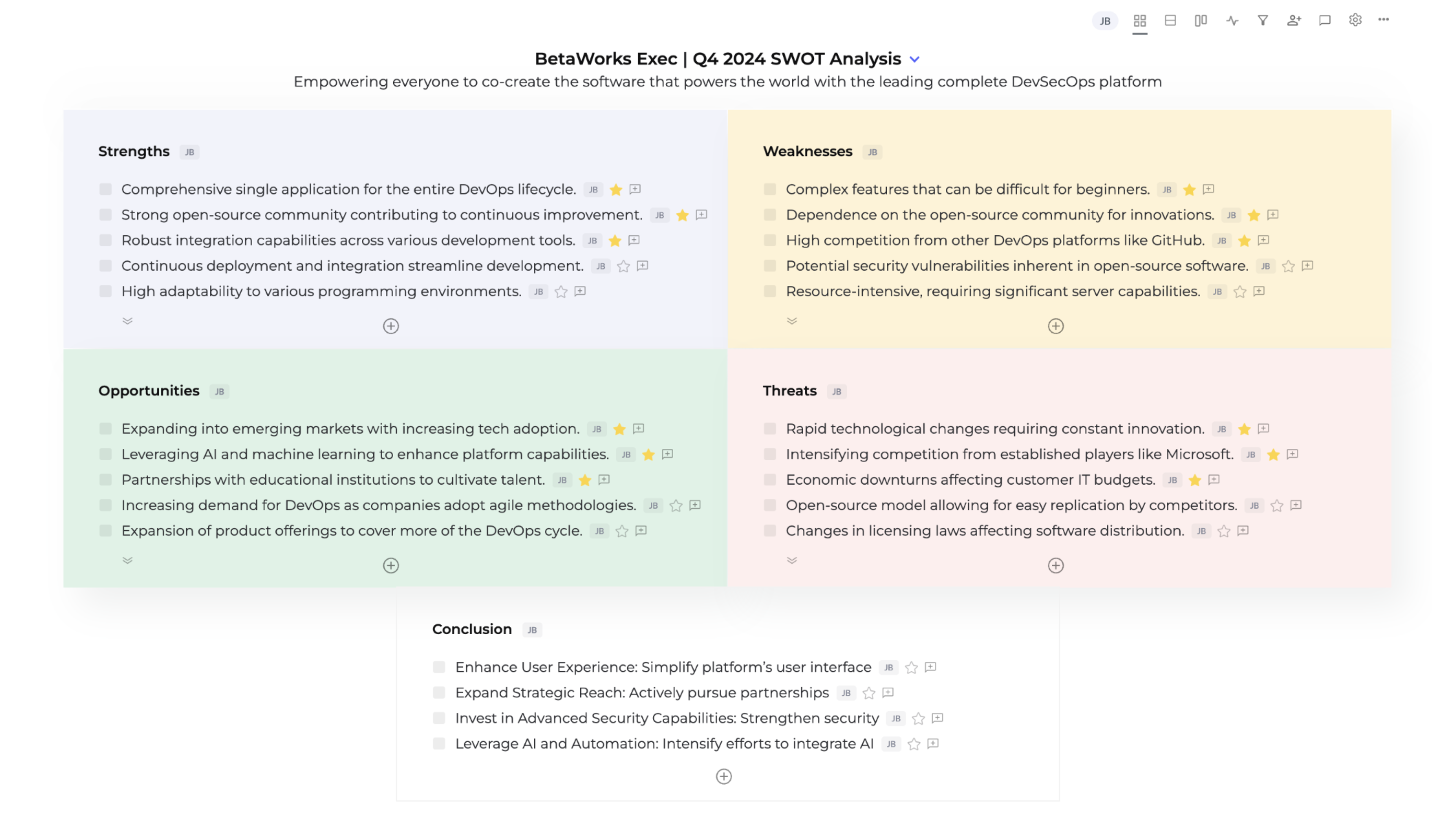
You're already using the alignment.io SWOT analysis template, excellent choice! This guide will walk you through maximizing its power to conduct an effective team SWOT analysis. Just like the image suggests, "Every team performs a SWOT," and alignment.io makes it easy to, as the image hints, "→ align the strategy."
This guide will provide a detailed, step-by-step process for conducting an effective SWOT analysis with your team directly within the alignment.io platform. Whether you're in "Workspace Exec Q4 2024," or any other context, mastering this template will equip your team to navigate challenges and capitalize on opportunities, all within your familiar alignment.io workspace.
Understanding the alignment.io SWOT Template and Team SWOT Benefits
The alignment.io SWOT template provides a structured digital space to collaboratively examine your team's Strengths, Weaknesses, Opportunities, and Threats. It leverages the benefits of digital collaboration, making team SWOT analysis more efficient and impactful.
Why use alignment.io for Team SWOT?
Using alignment.io offers specific advantages for team SWOT analysis:
- Collaborative Workspace: alignment.io is designed for teamwork. Everyone can contribute to the SWOT in real-time, regardless of location.
- Structured Template: The template provides clear sections for Strengths, Weaknesses, Opportunities, and Threats, keeping your analysis organized.
- Digital Brainstorming: Easily add ideas directly into the template, eliminating the need for separate documents or whiteboards.
- Built-in Prioritization (Likely): alignment.io templates often include features for voting or prioritization, allowing the team to collectively focus on the most important SWOT points. (We’ll assume it has a voting/prioritization feature – likely using a "star" or similar icon as you previously asked about).
- Action Planning within the Platform: Potentially, alignment.io may allow you to directly link SWOT points to action items and track progress within the same platform, streamlining the strategic alignment process ("→ align the strategy").
- Centralized Documentation: Your entire SWOT analysis, including brainstorming points, prioritizations, and potentially action plans, is stored in one easily accessible place within alignment.io.
- Mobile Accessibility for Contribution On-the-Go: alignment.io likely offers mobile apps and mobile-responsive web access. This makes it incredibly easy for team members to contribute to the SWOT analysis from anywhere, at any time, using their smartphones or tablets. Whether they are in the field, traveling, or simply away from their desks, team members can add ideas, vote on priorities, and stay engaged in the SWOT process, ensuring broader participation and more comprehensive input.
When to Perform a Team SWOT using alignment.io?
The optimal times to leverage the alignment.io SWOT template are similar to general SWOT analysis occasions:
- Strategic Planning Sessions (like "Workspace Exec Q4 2024 SWOT"): When defining team goals and strategies for a quarter, year, or project.
- Problem-Solving: When facing challenges, use alignment.io SWOT to diagnose issues and brainstorm solutions collaboratively.
- Project Kick-offs: Assess project viability and risks using the template at the start of new initiatives.
- Performance Reviews: Periodically evaluate team performance and identify areas for growth.
- Change Management: Analyze the impact of organizational changes and plan adaptation strategies.
- Competitive Analysis: Understand your team's position in the competitive landscape.
Step-by-Step Guide to Performing a Team SWOT Analysis in alignment.io
Let's walk through the process of conducting a team SWOT analysis using your alignment.io template:
Step 1: Preparation within alignment.io
- Access the alignment.io SWOT Template: Navigate to your alignment.io workspace and open the SWOT analysis template you'll be using. Ensure you've created a new instance of the template for your specific team or project.
- Define the Scope (within the automatically generated tile title): alignment.io automatically creates a tile for your SWOT analysis with a structured title format: workspace / team / timeframe / project label. For example, your tile might be automatically named "BetaWorks / Exec / Q1 2025 / SWOT Analysis". This system-generated title already provides a clear, standardized scope, ensuring everyone understands what workspace, which team, and for what timeframe and project label the SWOT is being conducted. This built-in structure helps maintain clarity and organization across your alignment.io workspace.
- Include a Clear Team Mission or Objective at the Top of the Template: Beyond the tile title, explicitly state your team's overarching mission or a clear, specific objective at the very top of the SWOT template itself within alignment.io. This provides crucial context for the analysis. For example, at the top of the template, you might write: "Team Mission: To become the market leader in innovative Widget solutions" or "Objective for Q1 2025: Successfully launch Product Alpha and achieve 10,000 active users." Having this mission or objective clearly visible as the starting point of your SWOT ensures that all brainstorming and prioritization is directly aligned with your team's core purpose or immediate goal.
- Invite Team Members to the alignment.io Workspace: Ensure all relevant team members have access to the alignment.io workspace and the specific SWOT template you've created. Share the link to the template with participants.
- Schedule a Virtual or In-Person Session: Schedule a dedicated time for your team to work on the SWOT analysis together. Even if team members are geographically dispersed, alignment.io facilitates real-time collaboration.
- Assign a Facilitator (Optional but Recommended): Designate someone to facilitate the session. They will guide the discussion, keep it focused within the alignment.io template, and ensure everyone contributes.
Step 2: Brainstorming Directly in the alignment.io Template
- Introduce SWOT and Objective (using the platform's communication features): At the start of your session (whether virtual or in-person), use alignment.io’s communication features (e.g., chat, built-in meeting link if available, or simply verbally if in person) to reiterate the purpose of the SWOT analysis and the defined scope.
- Brainstorm Strengths (S) - Directly in the "Strengths" Section of alignment.io: Direct team members to the "Strengths" quadrant/section within the alignment.io template. Encourage them to add their ideas directly as individual items within this section. Use questions like:
- "In alignment.io, let's add our team's strengths to the 'Strengths' section. What does our team do exceptionally well?"
- "What key skills, talents, and expertise should we list under 'Strengths' in alignment.io?"
- "What advantageous resources should we document as 'Strengths' within alignment.io?"
- Example Action: "Everyone, please start adding 2-3 strengths you think are most relevant for our team directly into the 'Strengths' section of our alignment.io template now."
- Brainstorm Weaknesses (W), Opportunities (O), and Threats (T) - Similarly within alignment.io Sections: Repeat the brainstorming process for "Weaknesses," "Opportunities," and "Threats," guiding team members to add their ideas directly into the corresponding sections of the alignment.io template. Use the question prompts from the generic guide, but always frame them within the context of adding items directly to the alignment.io template sections.During Brainstorming within alignment.io:
- Add Ideas Individually: Encourage team members to add each idea as a separate, distinct item within the template. This makes prioritization easier later.
- No Need for Separate Capture: Ideas are captured directly within alignment.io – no need for flip charts or other tools!
- Real-time Visibility: Everyone can see ideas being added in real-time, fostering collaboration and sparking new ideas.
Step 3: Discussion and Prioritization within alignment.io - Leverage Voting!
- Review and Clarify (within alignment.io list view): Once brainstorming is complete, review the lists within each SWOT section in alignment.io. Use alignment.io's features (if available, like comment threads on items, or built-in chat) to clarify any points directly within the platform.
- Combine and Group (potentially by dragging and dropping or editing within alignment.io): If alignment.io allows for it, look for similar items and either combine them by editing or group them visually within the platform if such features exist. This reduces redundancy and organizes the lists.
- Prioritize Key Items - Using alignment.io's Voting Feature (Star Icon!): Now, leverage alignment.io's likely built-in voting functionality!
- Initiate Voting: If alignment.io has a voting feature (look for a "star" icon or similar next to each item, or a "vote" action), explain to the team how to use it.
- Star Vote on Items: Instruct team members to click the "star" (or equivalent icon) next to the items they believe are most important within each SWOT category in alignment.io. Allocate a certain number of votes per person per category (e.g., 3 stars per person per category).
- Silent Voting in alignment.io: Encourage silent voting by having everyone vote individually within alignment.io without verbal discussion first.
- Voting Period (Time-box using your session time): Set a short voting period (e.g., 5 minutes).
- View Vote Tally in alignment.io: alignment.io should automatically tally the votes. Look for a vote count next to each item or a feature to sort items by vote count.
- Discuss Top Voted Items (using alignment.io's communication or verbally): Focus your discussion on the top-voted items directly within alignment.io. Use alignment.io's communication features or verbal discussion to explore why these items were prioritized.
Step 4: Develop Action Plans - Potentially within alignment.io (if features allow)
- Strategize Based on Prioritized SWOT Insights (using the prioritized lists in alignment.io): Using the prioritized SWOT points in alignment.io, discuss strategic actions. Consider SO, ST, WO, WT strategies (as described in the generic guide) based on your top strengths, weaknesses, opportunities, and threats identified in alignment.io.
- Define Actionable Steps (within alignment.io – if it has action planning features): If alignment.io offers action planning or task management features, directly create action items linked to your SWOT points within the platform. Define SMART action steps, assign ownership, and set deadlines – ideally within alignment.io if possible. If alignment.io doesn't have built-in action planning, note down action items separately, but clearly reference the relevant SWOT item from alignment.io.
Step 5: Documentation, Communication & Tracking in alignment.io
- alignment.io is your Documentation: The alignment.io template itself becomes your primary documentation of the SWOT analysis! No need to create separate summaries unless specifically required for external reporting.
- Share access in alignment.io for Communication: Simply ensure all relevant stakeholders have access to the alignment.io workspace and the SWOT template for ongoing communication and visibility.
- Regular Review and Updates in alignment.io: Schedule regular reviews of your SWOT analysis directly within alignment.io. Revisit the template (e.g., quarterly, as suggested by "Q4 2024") to track progress on action items (if managed within alignment.io), update the SWOT based on changing conditions, and re-prioritize as needed.
Next Step: From SWOT to OKRs – Using Your SWOT Conclusion to Set Strategic Objectives
You've now completed a comprehensive Team SWOT analysis using the alignment.io template – congratulations! But the analysis itself is only valuable if it drives action. A powerful next step, directly following your SWOT, is to use the insights you've gained, especially the summary you've captured in the "Conclusion" section of the alignment.io template, to inform the setting of your team's Objectives and Key Results (OKRs).
How the SWOT Conclusion Feeds into OKR Setting:
The "Conclusion" section of the alignment.io SWOT template is designed to be a concise summary of your key findings. It's the perfect bridge to translate your strategic analysis into concrete, measurable goals. Here’s how to leverage it for OKR setting:
- Review the "Conclusion" for Key Themes: Start by carefully reviewing the "Conclusion" you've written in alignment.io. What are the overarching themes that emerged from your SWOT? What are the most critical Strengths to leverage? Which Weaknesses must be addressed? What are the most promising Opportunities to pursue and the most significant Threats to mitigate? The Conclusion should distill these key takeaways.
- Identify Strategic Objectives from Opportunities and Threats: Your Opportunities and Threats are particularly crucial for setting strategic Objectives.
- Opportunities as Inspiration for Objectives: Many of your Objectives will likely stem from the Opportunities you've identified. Ask: "Based on these Opportunities, what ambitious yet achievable goals can we set for the next quarter, year, or project cycle?" Opportunities point towards where you should aim to grow and improve. For example, if an Opportunity is "Emerging market for X," a related Objective could be "Establish a strong foothold in the X market by Q[Next Quarter]".
- Threats as Areas for Defensive Objectives: Threats might inform Objectives focused on risk mitigation or strengthening your position. Ask: "Considering these Threats, what Objectives should we set to protect our team and minimize potential negative impacts?" For example, if a Threat is "New competitor Y entering the market," a related Objective could be "Increase customer retention rate by 15% in the next quarter to solidify our market share."
- Use Strengths to Achieve Objectives and Address Weaknesses: Your Strengths and Weaknesses inform how you will achieve your Objectives.
- Strengths as Enablers: Leverage your identified Strengths to achieve your Objectives. Recognize that your Strengths are the resources and capabilities you can rely on. When setting Key Results for your Objectives, consider how you can specifically utilize your Strengths to drive progress.
- Weaknesses to Inform Key Results and Initiatives: Your Weaknesses highlight areas that need improvement. While Weaknesses themselves are generally not framed as Objectives, understanding them is crucial for setting realistic and targeted Key Results. You might set Key Results that directly address a Weakness, or you might define initiatives within your action plans that aim to overcome specific Weaknesses to ensure Objective achievement.
- Translate Qualitative SWOT Insights into Quantifiable Key Results: OKRs are most effective when Key Results are measurable. After identifying your Objectives from the SWOT Conclusion, think about how to quantify success. For each Objective, define 2-3 Key Results that are specific, measurable, achievable, relevant, and time-bound (SMART). Refer back to your SWOT points when crafting these Key Results to ensure they directly support your strategic direction.
Example:
Let's say your SWOT Conclusion in alignment.io highlighted:
- Opportunity: Growing demand for remote collaboration tools.
- Weakness: Limited internal expertise in advanced remote collaboration platform features.
Based on this, you might set the following Objective and Key Results:
- Objective: Enhance our team's remote collaboration capabilities to effectively meet growing client needs and improve internal efficiency by Q[Next Quarter].
- Key Result 1: Train 90% of team members on advanced features of our primary remote collaboration platform (Alignment.io itself, perhaps!).
- Key Result 2: Decrease average project completion time by 10% by leveraging remote collaboration tools more effectively, as measured by project management software.
- Key Result 3: Achieve a client satisfaction score of 4.5 out of 5 on remote collaboration effectiveness in post-project surveys.
In Conclusion:
Your team SWOT analysis, especially when effectively summarized in the "Conclusion" section of your alignment.io template, provides a powerful strategic foundation. By consciously using these insights to define your Objectives and Key Results, you ensure that your team's efforts are directly aligned with your strategic priorities, turning your analysis into tangible progress and achieving meaningful outcomes. Remember to regularly revisit your SWOT and OKRs in alignment.io to stay strategically agile and responsive to the ever-changing business environment.